Lecture 1A: What and where is the resistance?
Category
Published on
Abstract
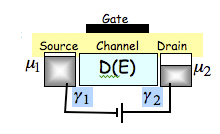 Objective: To introduce a simple quantitative model that highlights the essential parameters that determine electrical conduction: the density of states in the channel, D and the rates at which electrons hop in and out of the two contacts, labeled source and drain. This model is used to explain diverse phenomena such as (1) why a small conductor has a maximum conductance that it cannot exceed even with the best of contacts, (2) how this conductance quantum evolves into Ohm’s law for large conductors, (3) how even a hydrogen atom can exhibit thermoelectric effects, (4) how even symmetric devices can be rectifying due to asymmetric electrostatics, and (5) how the “voltage” varies spatially inside a nanoscale device.
This lecture is part 1 of 2.
Sponsored by
Cite this work
Researchers should cite this work as follows:
Time
Location
Purdue University, West Lafayette, IN