You must login before you can run this tool.




Category
Published on
Abstract
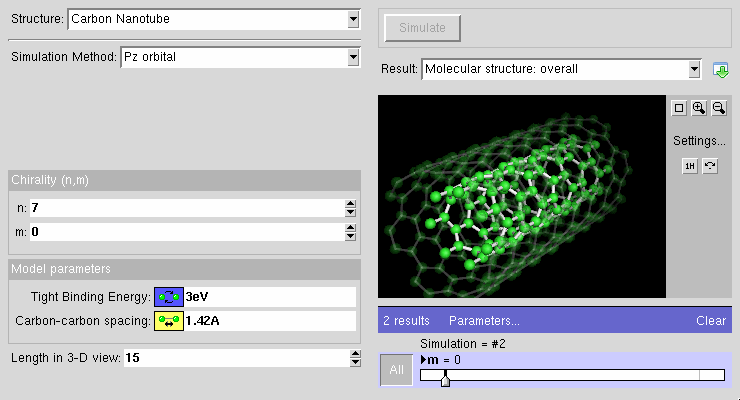
CNTbands can simulate electronic band structure and density of states for carbon nanotubes (CNT), as well as graphene nanoribbons (GNR). It also computes some basic parameters, such as nanotube diameter, number of hexagons in the unit cell, and band gap. Users may select the GNR structure to be simulated by selecting a starting point and components for a chiral vector. CNTs are simulated either with a simple Pz orbital model or Extended Huckel theory. The Extended Huckel model can deliver more accurate simulation results, especially for small-diameter CNTs. Tool versions
- Version 2.5 includes (1) treatment of spin polarization along the zigzag edges of GNRs and (2) edge bond relaxation effect for armchair GNRs.
Here are some nanoHUB resources related to carbon nanotubes (CNT) and graphene nanoribbons (GNR):
- This tutorial introduces various nanoelectronics simulation tools, including CNTbands
- A learning module is also available for CNT and GNR
- Another learning module is available for CNTbands.
- Professor Supriyo Datta has a lecture on CNT.
Credits
Thanks to the following people for their contributions to this work:
| Gyungseon Seol | ... GNR Simulation Scripts including edge effects |
| Youngki Yoon | ... GNR Simulation Scripts |
| Diego Kienle | ... Extended Huckel Theory Script |
| James Fodor | ... Documentation |
| Jing Guo | ... CNTbands |
| Akira Matsudaira | ... Rappture code for CNTbands 1.0 |
This project was funded by the Network for Computational Nanotechnology.
CNTbands 1.0 was written in 2002 by J. Guo of Purdue University. It was based on a script by M. P. Anantram of NASA Ames Research Center and the paper, L. Yang, M. P. Anantram, and J. P. Lu, "Band-gap change of carbon nanotubes: Effect of small uniaxial and torsional strain," Physical Review B, vol. 60, no. 29, pp. 13874-13878, 1999.
References
- K. Nakada, M. Fujita, G. Dresselhaus, M.S. Dresselhaus, "Edge state in graphene ribbons: Nanometer size effect and edge shape dependence," Physical Review B, 54(24), 17954 – 17961 (1996).
- J. Cerda and F. Soria, "Accurate and transferable extended Huckel-type tight-binding parameters," Physical Review B, 61(12), 7965 - 7971 (2000).
- Description of the basic model:Band-gap change of carbon nanotubes: Effect of small uniaxial and torsional strain, Phys Rev B, 60(19), 13874-13878 (1999).
- Good introduction to energy bands in CNTs:"Physical Properties of Carbon Nanotubes," by R. Saito, G. Dresselhaus, and M. Dresselhaus, Imperial College Press (1998).
- Some description of the value for the tight binding energy:Structural and electronic properties of pentagon-heptagon pair defects in carbon nanotubes, Phys. Rev. B 53, 11108–11113 (1996).
- Note that the graphene sheet model has limitations:Metallic and semiconducting narrow carbon nanotubes, by I. Cabria, J. W. Mintmire, and C. T. White2, Phys Rev B, 67, p. 121406, 2003.
- Description of Extended Huckel theory: D. Kienle, J. Cerda, and A. Ghosh, Extended Huckel theory for band structure, chemistry, and transport: I. carbon nanotubes, J. Appl. Phys., vol. 100, p. 043714 (2006).
- Description of spin polarization along the zigzag edges of GNRs : Jing Guo, D. Gunlycke, and C. T. White, Field effect on spin-polarized transport in graphene nanoribbons, Appl. Phys. Lett., 92, 163109 (2008).
Cite this work
Researchers should cite this work as follows:
-
-
If you use the Pz-orbital model, please cite: L. Yang, M. P. Anantram, and J. P. Lu, "Band-gap change of carbon nanotubes: Effect of small uniaxial and torsional strain," Physical Review B, vol. 60, no. 29, pp. 13874-13878, 1999.
-
If you use the Extended Huckel model, please cite: D. Kienle, J. Cerda, and A. Ghosh, Extended Huckel theory for band structure, chemistry, and transport: I. carbon nanotubes, J. Appl. Phys., vol. 100, p. 043714 (2006).
-